Fuel for the future
Syria's manufacturing moment
Syria’s manufacturing sector is rich with opportunities waiting to be seized. Industrialists are free from the predations of Bashar al-Assad’s regime, and from most of the sanctions that severed Syria from the world. The return of displaced people offers plentiful working hands in cities once emptied of young men. Manufacturers in exile are impatient to revive their central role in Syria’s economy, producing the building materials, clothes, food, and medicine that will fuel Syria’s recovery. So far, though, this potential is pending. Opaque, erratic policies are not just preventing the return of businesses from abroad: They undercut producers who kept working amid war, siege, and sanctions, yet now struggle to survive the tumult of Syria’s transition.
It’s hard to say how many industrial facilities have shuttered since December 2024. But in cities like Damascus and Aleppo, with their proud traditions of manufacturing everything from clothes to medicines, stories abound of the sector’s recent decline. A businessman in Damascus cited a claim that, at some point in late-2025, 19 factories or workshops were shutting down per day. In the same timeframe, a local official alleged that some 5,000 workers had lost their jobs manufacturing backpacks in and around the capital. A young UN staffer, who focuses on private sector development, summed up the prevailing sentiment: “Industry is the sector that has suffered most from Syria’s liberation.”
The basic problem is straightforward. Compared with the days of Bashar al-Assad, Syrian producers face more import competition, higher production costs, and less state support. The country’s new leaders promptly slashed customs duties, flooding the market with cheap goods from Türkiye and beyond. Then they lifted subsidies for fuel and electricity, triggering a surge in energy prices made worse by the broader disruption caused by the American-Israeli attack on Iran. The return of displaced people has also driven up rents, including for industrial facilities. While working hands are affordable, many industrialists are forced to lay them off, because they can’t square their other costs. “I’ve fired half my employees in the last year,” said a textile manufacturer in Aleppo’s Sheikh Najjar industrial city, speaking in February 2026. “Honestly, I’m planning to sell all my machines and change sectors. I’m tired. I can make more money by selling my equipment than trying to actually work—and I’ll need fewer employees.”
Industrialists and policymakers blame each other for this impasse, in a communication breakdown that is itself part of the problem. Officials sometimes frame the sector’s pain as part of a necessary adjustment, as Syria moves from a relatively closed environment to a new era of intense market competition: “Syrian businessmen must improve the quality of their products,” said a senior policymaker in Damascus. “They lack an appetite for innovation and risk-taking. They must upgrade their machines, which have been there for 15 or 20 years.” An official in Aleppo echoed the point, while hinting at the suspicion with which Syria’s new leaders typically regard those who stayed in business under Assad: “Most of the businesses that are struggling today are those that worked with the former regime. They’re badly managed and have low quality. When the market opened, they were killed.”
Industrialists rightly object to this characterization. While Assad’s Syria had more than its share of crony capitalists and sclerotic state-owned factories, it also had thousands of mostly small and medium enterprises fighting to remain in business and pay their employees a living wage. They now feel abandoned, if not assaulted: “The government has us staring down the barrel of a gun,” said a businessman in Aleppo’s Chamber of Industry, in reference to the state’s current “do or die” approach. He, like many of his peers, readily admits that Syrian manufacturers must modernize everything from their machinery to their product design and training capacity. But he simultaneously argues that it can’t be done overnight. The textile manufacturer in Sheikh Najjar agreed: “The government wants us to modernize our machines. I bought my machines in 2005; I might get 10,000 dollars if I sell them, and then it will cost me at least 30,000 to replace them. How can I possibly do that with prices as they are now?” A third industrialist in Aleppo noted that he had invested $2.5 million to upgrade his machines back in 2021, when talk of Arab normalization with Syria buoyed hopes for the economy; given conditions today, he questions the wisdom of that decision.
It’s not just that the costs don’t add up: For some, the more fundamental problem is a lack of transparency, predictability, and inclusion in how economic policies are made. They point, for example, to the establishment of a nebulous Sovereign Wealth Fund administered by President Ahmad al-Sharaa, and a powerful new customs authority headed by a close Sharaa ally. They note the uncertainty created by the Illicit Gain Combating Committee, which continues to seize vast assets allegedly tainted by links to the former regime, although it hasn’t bothered to clarify how assets are targeted or used once they’ve been confiscated. And they resent the more general sense that Syria’s new authorities seem to view them as a relic to be phased out rather than partners to work with. The member in Aleppo’s Chamber of Industry put it simply, reflecting a widely-shared feeling of exclusion: “We want to collaborate in decision-making.”
As the two sides disagree on who’s to blame for the impasse, they also differ on how to fix it. Officials are keen to attract big ticket investments from foreign companies and the Syrian diaspora, which they argue will invigorate the market and spur the right kind of competition. A businessman in Aleppo’s Chamber of Commerce summed up an attitude common in official circles: “We’re looking to bring in large factories that will make the entire economy work, including to the benefit of small and medium enterprises which will supply them.”
Yet this optimistic narrative glosses over a key fact: The same problems that undermine existing Syrian producers also deter new investments from abroad. If opaque, arbitrary decision-making is a problem for small Syrian businesses, it’s a non-starter for multinationals. “Speak to any foreign bank or company about working in Syria,” argued a pharmaceuticals manufacturer, “and they’ll say the same thing: Syria must get its act together first.” As much can be said of high production costs. “Why would you invest in Syria when you could invest in Egypt?” asked the UN staffer working on private sector development. “Egypt has cheaper industrial real estate, cheaper labor, cheaper electricity, and in some fields higher skills.”
These obstacles help explain the fact that dozens of memoranda of understanding (MoUs) promising international investments have produced scant results, despite the authorities’ emphasis on attracting foreign capital. “It’s been a year since the MoU circus began,” remarked a frustrated investor in Damascus, speaking in May 2026. “They have produced virtually nothing.”
While new initiatives remain scarce, the sector’s decline is rippling out into Syria’s ravaged economy. Even at the worst of the war, manufacturing continued to employ a diverse array of low- and high-skilled workers, including marginalized groups like women and rural migrants. It provided not just for full-time workers and their families, but also for part-time auxiliary staff like truck drivers. In Aleppo, whose whole economy was wired around manufacturing, the doorman of an apartment building explained how the sector’s post-Assad decline has deprived him of his second job driving a delivery van for textile factories. The gig typically earned him 100 dollars per week: higher than the salary of a typical civil servant, and a lifeline for a man now struggling to feed his 12 children amid soaring costs of living.
The sector’s high stakes and declining fortunes have made it an arena for fierce political contestation—which is itself a positive sign of Syria’s post-Assad political space. Aleppo’s Chamber of Industry has publicly clashed with Syria’s leadership earlier this year, prompting President Sharaa himself to pay a visit to the city. In June 2026, Syria’s Ministry of Economy sponsored a high level conference on the role of the private sector; participants openly criticized government policies at an event attended by hundreds, including ambassadors and ministers. The government’s detractors welcome the ability to voice their criticism aloud—although they note that such debates are scattered and ad hoc, producing occasional concessions rather than structural change.
What Syria needs, therefore, is an industrial policy forged through clear, institutional channels—one that taps existing resources to jumpstart the economy and generate jobs, rather than betting on foreign investments that may or may not materialize. Manufacturers in Syria know what’s missing, starting with a baseline of support that would let them survive long enough to modernize: partial subsidies for electricity, affordable water, and access to industrial credit would go a long way, especially if paired with investments in vocational training. They dream of economic diplomacy to unclog trade with Lebanon, Jordan, and Iraq, and to rebalance today’s lopsided relationship with Türkiye. They call for a tariff schedule to be hashed out with structured input from Syrian trade groups, rather than rolled out by fiat. And indeed, they crave a broader shift away from the logic of presidential decrees, sovereign funds, and the shadowy reallocation of assets, and toward a system where the economy is legislated—not just debated—in public.
Critically, the above should appeal not just to Syrian manufacturers, but to many of Syria’s foreign backers. Gulf states, eager to invest in Syria but daunted by its riskiness and dysfunction, have every reason to throw their weight behind an industrial policy underpinned by core reforms to economic governance. European nations, impatient to see refugees return and keen to support their own multinationals entering the Syrian market, likewise have much to gain. They have spent years funding entrepreneurship and vocational training for Syrian refugees; they can now capitalize on this investment, by helping Syria’s manufacturing sector to reabsorb that human capital. They can support not just with grants and concessionary loans, but by embedding that support with technical assistance. That is what it will take to revive local production, which in turn will enable Syrians to revive their country, on their terms.
Maya Chehade is a consultant with Synaps. Alex Simon is Synaps' research director.
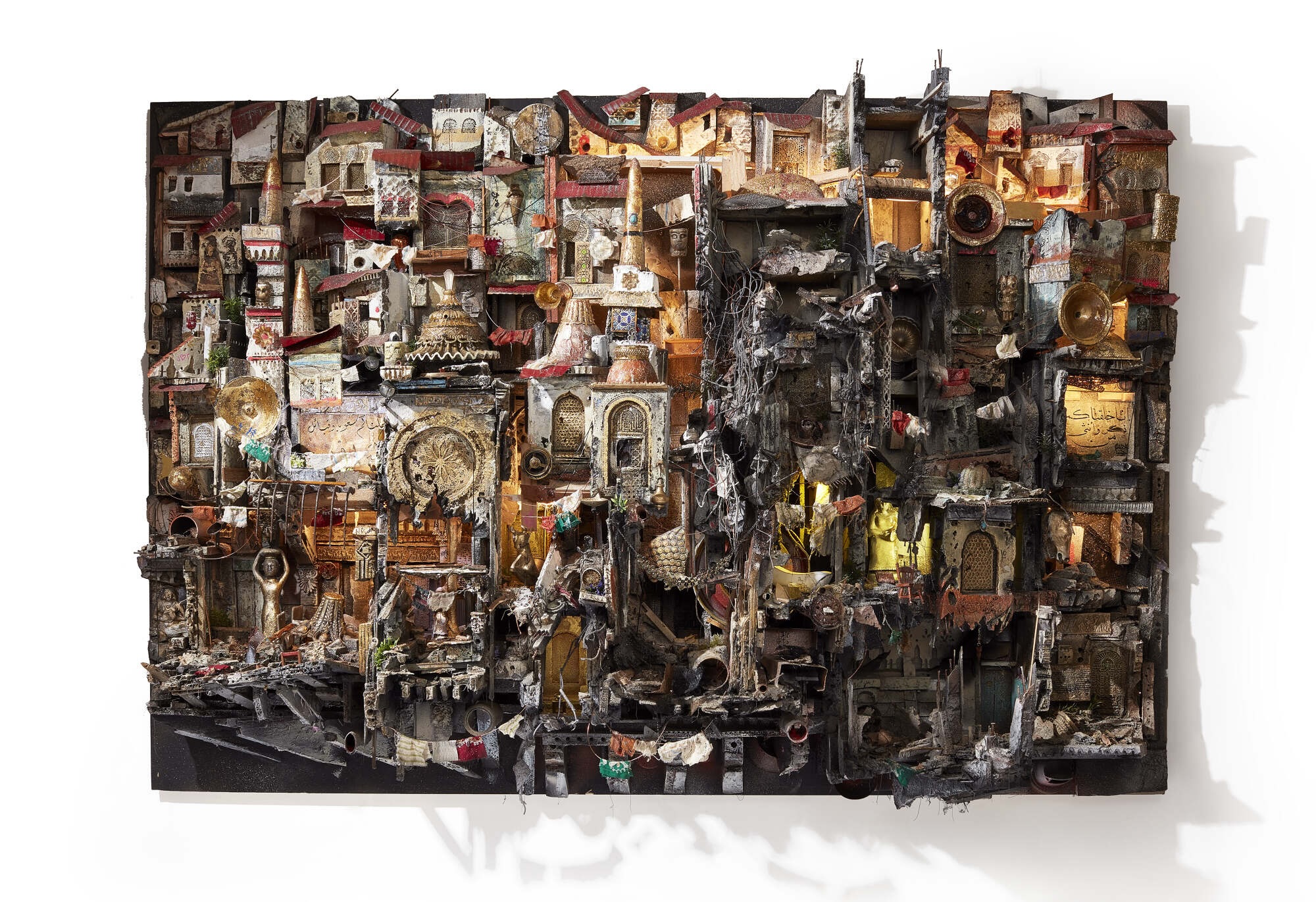
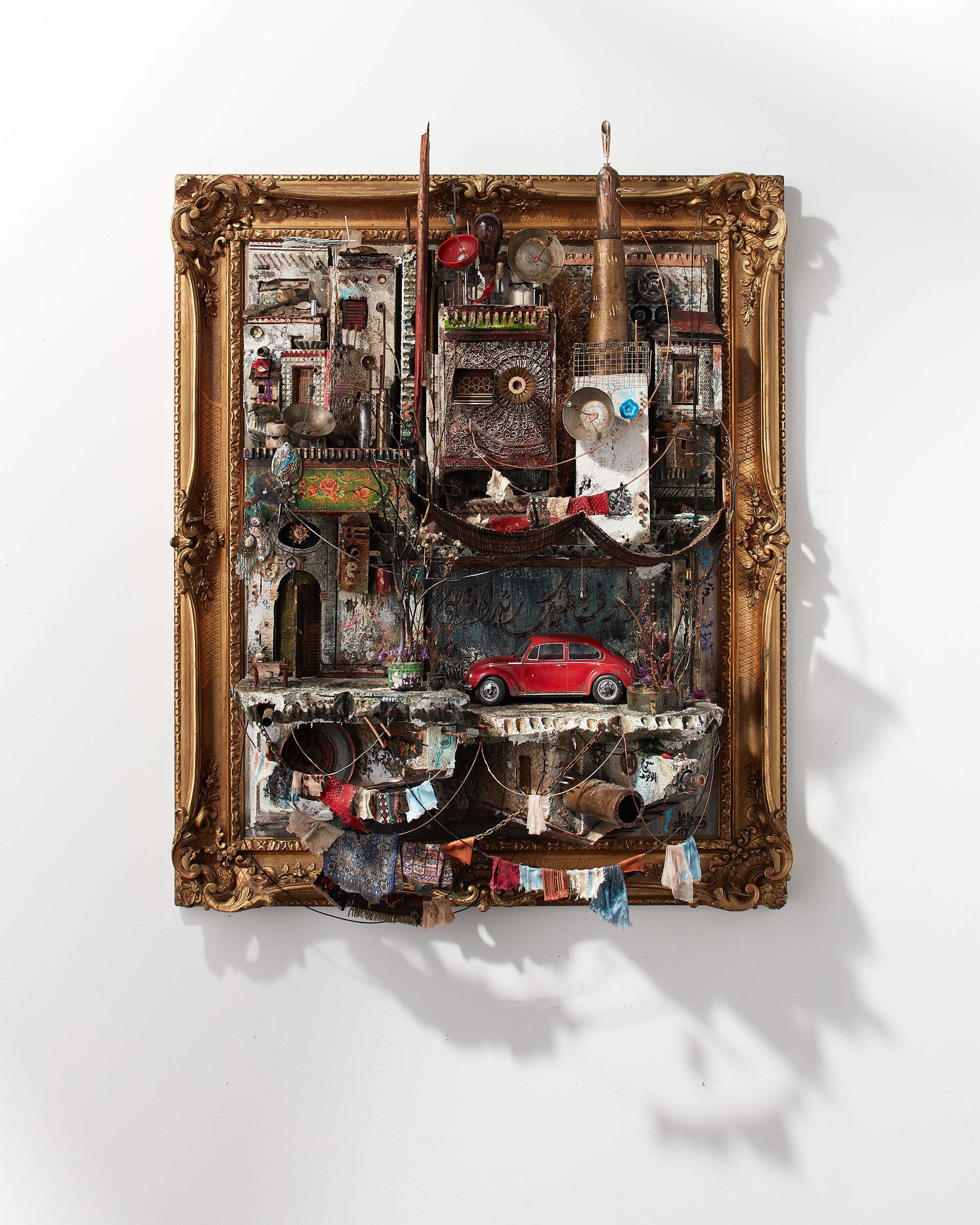
Grateful illustration credit: Mohamad Hafez, Eternal Cities (2023) and Framed Nostalgia 1 (2019).